Wednesday, January 31, 2018

The Loco Foco line and the Salt River


1841—W. H. Harrison sends the steam boat Van Buren up the Salt River on the Loco Foco Line
The entry in the Dictionary of American History explains that the phrase, 'rowing up Salt river,' emerged during the 1832 presidential campaign, which pitted Andrew Jackson against Henry Clay. Clay reportedly hired a boatman to bring him up the Ohio River to Louisville where he was scheduled to deliver a campaign speech. As a supporter of Jackson, however, the boatman, mistakenly or perhaps deliberately, rowed Clay up Salt River, a branch of the Ohio, thus delaying his arrival in Louisville and causing him to miss his speaking appearance. Clay eventually lost the election, but whether or not the boatman's wrong turn contributed to the loss cannot be proven. According to some scholars, the phrase emerged in an 1839 congressional speech, and by 1840 it had been adopted in campaign songs. 

As interesting as the story about Henry Clay is, it cannot be accurate, for the expression was commonplace before 1832, as witnessed in a letter that Franklin Pierce wrote that is dated 8 Oct 1831. In it on the third page, Pierce said, "the plotters need not now struggle to change the direction of their squadron, they are politically 'rowed up Salt river.'"

The Louisville (Ky.) Advertiser gives the following description of Salt River:  Salt River is a small stream in this State, which empties into the Ohio River about twenty miles below this city. In the neighborhood of Shepherdsville, where the phrase of 'rowing up Salt river' originated, it is filled with rapids, snags, rocks, sandbars, &c. Of course, the navigation is extremely difficult, and rowing up Salt River is a matter not to be sneezed at. The labor attending it was so well known to those residing in the vicinity, that it became common among them, whenever anyone spoke of some very arduous undertaking, to tell him that he would find it harder than trying to row up Salt River. When some bully had received a sound whipping, it also became common to say that he had been 'rowed up Salt river,' and the same remark was likewise applied to a defeated political party. If the defeat was overwhelming, they were said to be 'rowed very far up Salt River.'

According to Wikipedia, Locofocos were a faction of the Democratic Party that existed from 1835 until the mid-1840s.  The faction was originally named the Equal Rights Party, and was created in New York City as a protest against that city’s regular Democratic organization (“Tammany Hall”). It contained a mixture of anti-Tammany Democrats and labor union veterans of the Working Men's Party.
The name “Locofoco” derives from “locofoco,” a kind of friction match. It originated when a group of New York Jacksonians used such matches to light candles to continue a political meeting after Tammany men tried to break up the meeting by turning off the gaslights. The name Loco-foco was originally used by John Marck for a self-igniting cigar, which he had patented in April 1834.  Marck, an immigrant, invented his name from a combination of the Latin prefix "loco", which as part of the word "locomotive" had recently entered general public use, and was usually misinterpreted to mean "self", and a misspelling of the Italian word "fuoco" for "fire.”  Therefore, Marck's name for his product was originally meant in the sense of "self-firing". It appears that Marck's term was quickly genericized to mean any self-igniting match, and it was this usage from which the faction derived its name.
The Whigs quickly seized upon the name, applying an alternate derivation of "Loco Foco", from the combination of the Spanish word "loco", meaning mad or crack brained, and "foco", from "focus". Their meaning then was that the faction, and later the entire Democratic Party, was the "focus of folly".  The use of "Locofoco" as a derogatory name for the Democratic Party continued well into the 1850s, even following the dissolution of the Whigs and their reformation as the Republican Party.
Never a national party, the Locofocos reached their peak in 1840, when President Martin Van Buren and Congress passed the Independent Treasury Act, which fulfilled a primary Locofoco aim: complete separation of the federal government from banking.  In the 1840 election, the term "Locofoco" was applied to the entire Democratic Party by its Whig opponents, both because Democratic President Martin Van Buren had incorporated many Locofoco ideas into his economic policy, and because Whigs considered the term to be derogatory.
In general, Locofocos supported Andrew Jackson and Van Buren, and were for free trade, greater circulation of specie, legal protections for labor unions and against paper money, financial speculation, and state banks.

Chrome Browser Problems--fixed

So, what's been going on with the Google Chrome browser? I started using it years ago instead of Internet Explorer on Windows 7.  It worked fine with the default settings.  About a year after I installed Windows 10, Chrome started to have problems. When I tried to load a page, a dialog box popped up, "connection was interrupted." A change to a setting in Chrome fixed that. Then, when I tried to open a new page, I got the little circle of moving dots, and the page would not open. A change to another  Chrome setting fixed that. Then, when I tried to open a web page, I got a message that said "loading proxy..." Sometimes the page opened after a couple of minutes, sometimes not. That one required a change to my Windows 10 LAN settings. It's a good thing I had the Microsoft Edge browser so I could find the fixes on the internet along with hundreds of other Chrome users that had the same problems. Chrome is having problems it did not have before with Flash games, too, but that's another story... I like to use two browsers. I dial up some classical music on Edge, play a game on Chrome, and use the audio mixer to lower the volume of the game sounds on Chrome.

Friday, April 14, 2017

From Canal Boy to President


From Canal Boy to President

One of the more common campaign items for James Garfield is a token that celebrates Garfield’s humble beginnings working as a tow boy on the Ohio and Pennsylvania Canal.

   
After President Garfield’s assassination in 1881, the theme from Garfield’s campaign became the perfect basis for a biography by the popular children’s author, Horatio Alger Jr.


Horatio Alger Jr. (January 13, 1832 – July 18, 1899) was a prolific American author whose writings were characterized by a "rags-to-riches" narrative.  In January 1867, the first of 12 installments of Ragged Dick appeared in a magazine, Student and Schoolmate. The story, about a poor bootblack's rise to middle-class respectability, was a huge success. It was expanded and published as a novel in 1868.  It proved to be Alger’s best-selling work, and a model for his many children’s novels that followed.

In 1881, Alger wrote “From Canal Boy to President; or, The Boyhood and Manhood of James A. Garfield.”
The book sold well, but more factual biographies are available. 

Thursday, October 20, 2016

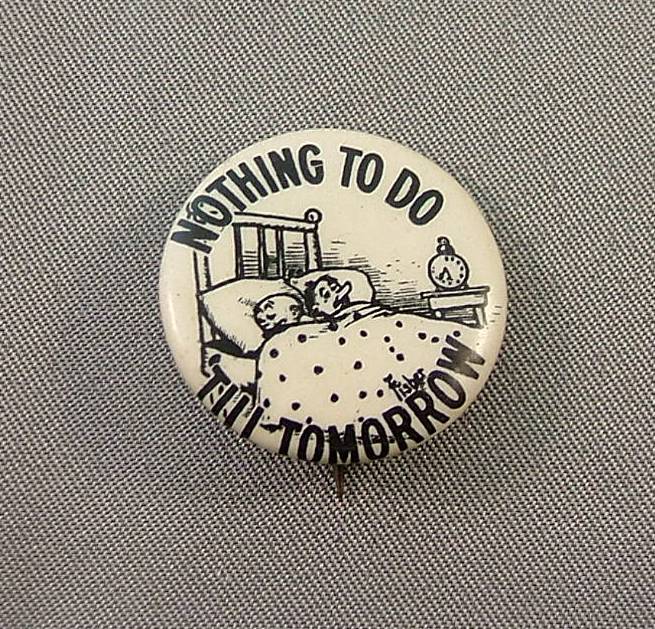
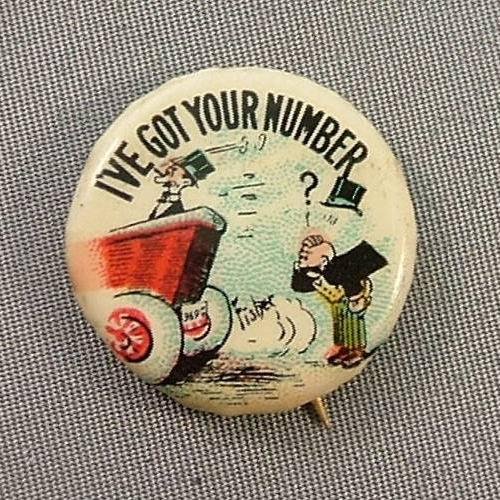
I also found the pin that, I believe, completes my collection of Bud Fisher designs for the Mutt and Jeff series of cartoon pins--30 pins, 29 phrases.  All of them were also issued as black and white images.  About 19 of them were used in a 1 1/4-inch color set.
I am glad to have found the original photograph from which Underwood & Underwood made the framed poster I have.  They cropped, re-touched, and colored the image.  It is amazing what they accomplished without having Photoshop software.


Friday, July 11, 2014

Theodore Roosevelt Picture Restored

A photograph of Theodore Roosevelt, probably taken during his 1904 presidential campaign, was hand-tinted, reproduced as a poster, and framed.  Most likely it hung for many years in a school class room somewhere.

When I acquired it, the frame was dirty and the glass had a six-inch crack across the lower right corner.  The backing board was a piece of (very acidic) corrugated cardboard.  One day, the picture fell from my office wall and the glass shattered.

I carefully removed the print and sprayed both sides of it with. Krylon Acid Free.  I cleaned the frame.  A local gallery re-mounted the picture in the original frame with an acid free back board and non-reflective museum glass.  The well-protected 18-inch by 22-inch framed picture again hangs in my office, looking much liked it did in that class room.


Thursday, April 10, 2014

Mutt and Jeff Update.

I thought there were 28 Bud Fisher designs in the Mutt and Jeff pin series, but apparently there are 29.  I just won the most recent in an auction:

 I still need 3 more to complete (I hope) the series:


Wednesday, January 29, 2014

Buttons from The Pan American Exposition, 1901


The event was organized by the Pan-American Exposition Company, formed in 1897.  Buffalo, New York, was chosen as the place to hold the Exposition.   The city was within a day's journey by rail for over 40 million people.  The "Pan American" theme was carried throughout the event with the slogan "commercial well being and good understanding among the American Republics."
The advent of the alternating current power transmission system in the US allowed designers to light the exposition in Buffalo using power generated 25 miles away at Niagara Falls.  The newly-developed X-ray machine was displayed at the fair.  Lina Beecher, creator of the Flip Flap Railway, attempted to demonstrate one of his looping roller coasters at the fair, but the organizers of the event considered the ride to be too dangerous and refused to allow it on the grounds.
The exposition is most remembered because President William McKinley was shot by an anarchist, Leon Czolgosz, at the Temple of Music on September 6, 1901.  The President died 8 days later.  President McKinley's speech at the exposition on the previous day included the following words:

"Expositions are the timekeepers of progress. They record the world's advancements. They stimulate the energy, enterprise, and intellect of the people, and quicken human genius. They go into the home. They broaden and brighten the daily life of the people. They open mighty storehouses of information to the student...."

These three souvenir buttons from the exposition are displayed side-by-side, possibly for the first time in over 100 years.  The first one has the words, “Official Button,” printed along the upper edge.
The picture of the bison obviously represents the city of buffalo. The symbolism of the dust pan and brooms is a little more obscure.  The middle badge alludes to “IN-DUST-RY,” while the button on the right proclaims, “NO DUST FOR US,” and “CLEAN SWEEP.”  Other souvenirs of the exposition were made in the shape of frying pans. One theory is that the pans somehow relate to the “pan” in “Pan American.”


Friday, December 6, 2013

Double Entendre

I just could not resist this pin:

Saturday, November 23, 2013

Another Musical Treat

I just acquired another cd in my exploration of the works of little known composers--String Quartets Nos. 1-3 by Anton Zimmerman on Naxos 8.553952. It is indeed thoroughly enjoyable listening.
 
From the notes on the CD, Wikipedia, and other on-line sources, I learned a little about Anton Zimmerman:

Silesian-born Anton Zimmermann was born in 1741 in Široká Niva (Breitenau); he died 1781, Bratislava.  He was a composer and contemporary of Joseph Haydn and Wolfgang Amadeus Mozart. Zimmermann spent most of his career in Bratislava, then capital of Hungary, where he worked as a composer, violinist, conductor, and artist manager.
The most important and influential post that this Austrian composer held was as the composer to Count Joseph Batthyany, the Archbishop of Hungary. He held this position  from 1776 until his death. As the first violinist he conducted from his chair performing instrumental secular works. Zimmermann composed approximately twenty five symphonies as well as numerous works in a variety of genres, including works for the stage, masses, offertories, concertos, nocturnes, and sonatas. He is considered to be one of the first composers to actually capture theatrical qualities in his melodramatic compositions. The sacred music which Zimmermann composed demonstrated his capacity for fugal developmental with full harmonic sonorities.
Modeled on those of Joseph Haydn, Zimmermann’s quartets and other chamber works for strings are noteworthy for their ‘symphonic” writing and expressive melodies, which set them apart from the decorative chamber music of many of his contemporaries.
His music has been recorded by, among others, the Musica Aeterna Soloists for the Naxos record label.
I continue to be impressed by the amount, variety, and quality of music that exists outside the realm of the musical giants.

Thursday, October 24, 2013

Theodore Roosevelt Visits Chehalis

While exploring a box of political odds and ends yesterday, I came upon what at first appeared to be a common 1-1/4” Theodore Roosevelt pin.  It’s in really poor condition. The shell of the pin is bent.  The paper is discolored.  The celluloid has several long cracks in it.  There is a hole punched right through the knot in Theodore’s tie.  At the top, is written “Our President.”  At the bottom is printed “Chehalis, May 22, 1903,” which, I think, makes this pin not so common after all.
When I researched the date and location, I learned that on May 22, 1903, during his campaign for the presidency, President Theodore Roosevelt visited Chehalis, Washington, and gave a 15-minute speech about hard work from atop the “McKinley Stump” at the intersection of West Street and Market Boulevard. 
Nearly 10,000 people attended, which must have made this a big event for a fairly small town:
In May 1901, The McKinley stump was cut from a 360-year-old Douglas Fir tree near Pe Ell in May, 1901 It was transported to Chehalis to serve as a speaking platform for President William McKinley. The trip was cancelled when McKinley’s wife took ill. A few months later, McKinley was assassinated, and Vice-President Roosevelt assumed the presidency. 
In 2007, the stump had to be removed because it was riddled with carpenter ants and internal rotting.  A replacement stump was put in place in 2008. 
An article describing the Roosevelt campaign event appears at the Washington State history site, http://www.historylink.org/index.cfm?DisplayPage=output.cfm&file_id=8373.


Monday, September 30, 2013

Hungarian Dances Revisited

I have always enjoyed an occasional listen to the Hungarian Dances by Johannes Brahms.

I own a budget cd on the ONYX label, an orchestral version by the London Festival Orchestra conducted by Alfred Scholz.  It's nothing special; it was the only one I could find at the time that had all 21 dances.  So, it has been just a "pretty listen."

Yesterday on internet radio, I heard a recording of the original version for piano, 4 hands.  It virtually knocked my socks off!  There were harmonies, dissonances, and rhythmic structures that seem to get lost in the orchestral versions.

It was such a wonderful experience I thought I should mention it.  Here is the summary information:

Performers:             Stign Kolacny and Steven Kolacny
Label:                      EtCetra Records
Catalog Number:     ETC 5250


Sunday, September 22, 2013

Yet another "hold-to-Light" Card

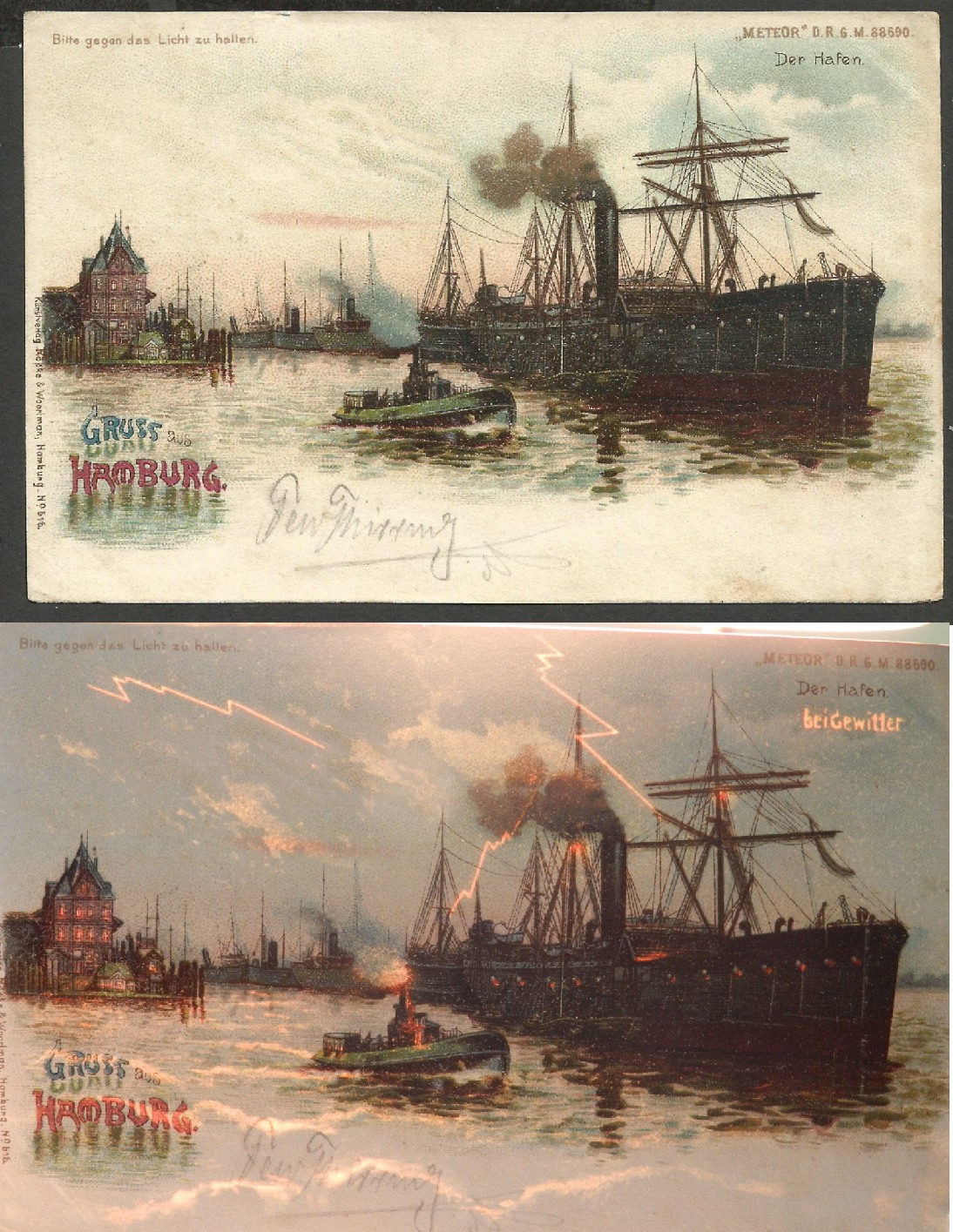
My collection of hold-to-light post cards continues to grow.  There are probably hundreds of cards in the "hold-to-light" category.  Most of them are scenic views; many are cartoons.  Except for the one card I have that depicts the town of Heidelberg, Germany, my collection is limited to those cards that depict ships.  In that restricted category, I have obtained 16 so far. This is the most recent acquisition:

Monday, August 12, 2013

Today I added a twelfth ship to my hold-to-light card collection.

Thursday, July 25, 2013

Another hold-to-light post card

Today I received the 11th addition to my collection of hold-to light post cards.  This one appears to have been made in 1899.  It depicts a ship called The Hare.  When you hold it up to the light, the words "In a Thunderstorm" appear under the ship's name.  The ship is a "hybrid," as it has both a steam engine and sails.   I think it is the most attractive one I have seen so far...

Wednesday, February 13, 2013

Update on Mutt and Jeff pins

I should probably be using my term, "Fisher pins," in the title, because the cartoons drawn by Bud Fisher are the only ones I am collecting from the Mutt and Jeff series of cartoon pins.  I have made considerable progress since I wrote about them in July.

As I continue to find 7/8-inch multicolor pins, I have learned of at least 28 designs in the Fisher series. I now have 25 in multi-color and 1 in black and white. Here are pictures of the 3 that I still need to find:


I also found and obtained two Fisher designs for one of the phrases; the first, and more common one depicts both Mutt and Jeff; the second, only Mutt. 


Finally, in addition to the 11 designs I already have in the 1-1/4 inch size, I learned that I need to find at least two more designs in the larger size:
 
While most of these pins are relatively inexpensive, the "OH YOU CUBS!" pins seem to be selling for around $85.00.  The higher price is probably because they fit in 3 areas of collecting:  cartoon phrases, tobacco premiums, and baseball memorabilia.
 
I still do not know how many illustrations Bud Fisher made for the cigarette pins, nor how many of them were produced in the 1-1/4 inch size.


Saturday, July 28, 2012

Mutt and Jeff Buttons

     Collecting political campaign buttons, I came across this pin designed by Bud Fisher, the creator of the cartoon strip, Mutt and Jeff:
     There are two sizes.  The 7/8 inch pin is made with a paper print covered with celluloid, and the 1 1/4 inch pin is lithographed directly on the tin.  Most likely, neither button was produced for campaign purposes.  In fact, many companies issued "Tie the bull outside" pins that either had no illustration at all, or depicted a bovine bull.  However, Bud Fisher was one of several cartoonists who were contracted around 1912 (Probably by Whitehead & Hoag company of Newark) to produce cartoons that illustrate popular conversational phrases of the day on buttons that would be issued by a tobacco company.  Apparently, Bud Fisher found the Progressive Party's symbolic bull moose irresistible to illustrate the phrase, "Tie that bull outside." 
     I eventually discovered more Mutt and Jeff pins.  Here are a few:
     I began to wonder just how many different Mutt and Jeff buttons there are.  A book called Buttons in Sets 1896-1972, by Marshall N. Levin and Theodore L. Hake, mentions both sets under the heading, "Comic Cartoons.  It identifies the 7/8 inch set as issued by Hassan and Tokio cigarettes and manufactured by Whitehead & and Hoag of Newark, New Jersey. Ehrman, and T. J. Gleason.  It further states that other cartoonists including Rube Goldberg, TAD, Hal Hoffman, George Herriman, George McManus, Tom McNamara, Rudolph Dirks, TEP, Gus Mager, HBM, and C.M. Payne contributed to more than 290 multicolor designs and over 170 black and white pins.   So far, I have seen 27 phrases that were illustrated with Bud Fisher drawings on 7/8-inch color pins.
     According to Levin and Hake, the manufacturer of the 1 1/4 inch set is not identified.  The back of each 1 1/4 inch badge contains the legend "Factory No. 30, 2nd District New York."  They state that 48 designs had been seen, and that artists include Bud Fisher, Rube Goldberg, and TAD.  The 48 known phrases are listed as well.
     I am interested, of course, only in the badges designed by Bud Fisher for the two sets, and I have been searching for "Mutt and Jeff buttons" on the internet for a few years now.  I decided I could obtain more results by searching the for each of the 48 known phrases as well.  That's when I learned that Sweet Caporal Cigarettes issued the cartoon phrases on cigarette cards.  These cards title the group "Mutt and Jeff Series."  They state that there are "over 250 designs," and they tie Sweet Caporal Cigarettes to Factory No. 30.
     My search on the phrases determined that some of the 48 phrases in Levin and Hake's list of 1- 1/4 inch pins were illustrated by cartoonists other than Bud Fisher.  My own collection includes 8 Mutt and Jeff phrases that are not in that list of 48, so the total number of 1-1/4 inch pins could be 56.  But it is probable that not all of the Fisher designs in the 7/8 inch series were included in the 1-1/4 inch series.
     Since the name, "Mutt and Jeff Series," is applied to a set that includes pins and cards designed by the other cartoonists, I plan to refer to my subset of the series as "Bud Fisher pins."
     Although I now know a lot more about my Bud Fisher pins, I still don't know how many there are.  Here is a  list of the phrases that I know were illustrated by Bud Fisher:
1.   Aw! Stick around awhile
2.   Beat it!*
3.   Can it!*
4.   Cut that stuff
5.   Dog on you!
6.   For the love of Mike, Mutt, be reasonable
7.   Good Night*
8.   Got cleaned last night
9.   I smell a rat
10.  I'm stuck on you*
11.  I'm the guy*
12.  I'm the guy that done it all*
13.  I'm through
14.  Is My Hat on Straight?
15.  I've got you
16.  I've got your number (version 1)*
17.  I've got your number (version 2)
18.  Lead me to it
19.  Let's see what you've got*
20.  Nothing to do until tomorrow
21.  Oh, just hanging around
22.  Oh you Cubs!*
23.  On your way
24.  Speak right out*
25.  Struck with delight*
26.  Take it from me, Bo.*
27.  Take that noise outside*
28.  Tie that bull outside*
*I found these designs in both sizes.

Sunday, May 27, 2012

Hold to Light

This instruction appeared on many post cards that were manufactured around the turn of the 20th century.  When the user holds the card up to a strong light, translucent portions of the card are illuminated from behind.  On some cards, an image appears in a normally blank space on the card.  On other cards, colored lights appear in windows, or reflections appear in the water.  The scene appears to change from day to night.  The card below, depicting the town of Heidelberg, Germany, shows the dramatic effect.


Of the hundreds of hold-to-light cards that were produced, only a few were made that depict ships at sea, or in a harbor.  So far, I have come across less than a dozen that depict ships.  The one that first caught my eye started my collection:


At this point, I have acquired 10 cards that depict ships.  Here are two more that illustrate the variety and drama that these novelty cards offer:


This last card is called a "meteor" card.  Unlike the others, which have cut-outs in a nearly opaque layer of the card, the entire meteor card is translucent in varying degrees. As you can see, the effect is pretty dramatic.

Today, movie films, television shows, YouTube videos that saturate us with vivid entertainment.  But 100 years ago, the novelty of post cards like these, along with stereoptican viewers and Edison cylinder phonographs were the state of the art for parlor entertainment.  I hope that you enjoy them as much as I do...

Wednesday, October 5, 2011

Beautiful Ohio

I recently found a button made in Columbus, Ohio. It is about 2 1/8 inches in diameter.

Although it is not a campaign button, it does mention the names of 5 presidents from Ohio. That helps to date the badge between 1900 and 1908, since the names of Taft and Harding do not appear.

What is interesting, is that by 1901 there had been 6 presidents from Ohio. Two of them were named Harrison (William Henry and Benjamin). Maybe the badge designer figured every one knows about both Harrisons, and used the name only once to save space. Or maybe he decided not to count William Henry, as he held office for only a month. I guess we will never know.

The badge has a picture of the State Capitol at the top, the State Seal in the center, and a picture of the Battle of Lake Erie on the right side.

The picture on the left side is the scene of a land battle. The question is, which one? My guess is it may be the 1794 “Battle of the Fallen Timbers," in which General “Mad Anthony” Wayne defeated a force consisting of Blue Jacket's Shawnees and Buckongahelas's Delawares, Miamis led by Little Turtle, Wyandots, Ojibwas, Ottawas, Potawatomis, Mingos, and even some Canadian militia.

The music at the bottom is “Home Sweet Home.” It seems strange to me that the designer did not use “Beautiful Ohio,” which became the official state song in 1889, before William McKinley became president.

Figuring out the history associated with the old buttons is part of the fun I get from collecting them...

Saturday, March 27, 2010

Post Cards with Flags

Here are a couple of old post cards from my collection. The first one was cancelled in 1909. When you know that, the picture of the flag presents 2 problems. Can anyone figure out what is strange about the flag?
The second one has a fanciful flag, and is an embossed card. I posted it just because it is attractive.


hit counter